
When it comes to high-performance surfaces for countertop, vanity, and cladding projects, engineered stone has become a go-to category. This guide is designed to give consumers a clear idea of what engineered stone is, how it differs by sub-type (quartz, porcelain, sintered stone), and what to consider when looking for the perfect stone for your project.
As in our other Beginner’s Guides (see quartzite, granite, and marble), we’ll break down engineered stone in a similar way: what it is, how it’s made, major benefits & limitations, applications, etc..
What Is Engineered Stone?
The term engineered stone is a broad category, covering all stone surfaces that are manufactured. Whereas natural stone is quarried, engineered stones are made in factories, using controlled processes, and serve to mimic or replace natural stone. These stone surfaces combine natural quartz crystals with resins and pigments. Examples of engineered stone include premium brands like Silestone, Caesarstone, RioMar, Neolith, and Dekton. In addition to quartz-based surfaces, we also offer Porcelain and Sintered Stone, both of which fall under the engineered stone category; however, not all fabricators in St. Louis work with these stones (we do!).
Why is this terminology important? Because different engineered stone types behave differently during fabrication, installation, and long-term in your home. It’s essential to know whether you’re working with quartz-based stone, porcelain, sintered stone, or something else altogether.
For a broader look at how engineered stone compares to natural stone and other materials, explore the ultimate guide to stone fabrication to help you choose the right option for your space.
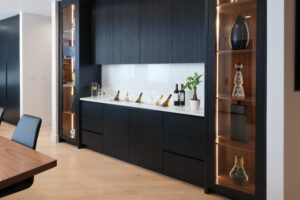
Types of Engineered Stones:
Quartz
- Made from natural quartz crystals crushed and bound with polymer resins and pigments.
- Non-porous (thanks to the resin binder) so it often doesn’t require sealing.
- Produces very consistent slabs in color/pattern, which is attractive for many clients seeking uniformity.
- Within the engineered stone category, it’s probably the most familiar to clients and fabricators.
Porcelain & Sintered Stone
- These two are often lumped together, but they’re not identical.
Porcelain and Sintered Stone are both extremely hard stones and produced through a process of ‘sintering’. However, the products are not the same, as they are created using different raw materials.
- Porcelain: typically refined clay + other minerals, fired at high temperature
- Sintered Stone: made from natural minerals (quartz, feldspar, etc.) under extreme heat & pressure, no (or minimal) resin binders.
Key takeaway: All three — quartz engineered stone, porcelain slabs, sintered stone — fall under the “engineered stone” umbrella. But their manufacturing processes, properties, and best-uses differ significantly.
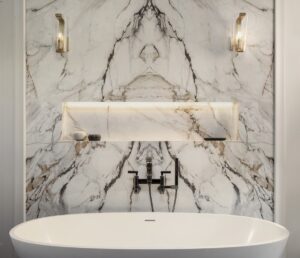
Recommended Applications by Type
Quartz
- Best for: Environments where you want a durable, low-maintenance surface and either a uniform look or intentionally designed pattern.
- Caution: Not ideal for direct outdoor exposure (UV issues) or extreme high-heat environments (e.g. cast-iron heavy use), unless explicitly stated otherwise by the manufacturer.
 Porcelain Slabs
- Best for: Wall cladding, floors (depending thickness), vanity tops, seamless large format installations. Particularly good when you want slab aesthetics with thin profiles and minimalist seams.
- Caution: Fabrication may be more complex (due to brittleness/thickness), and edge profiles may be more limited.
Sintered Stone
- Best for: Premium indoor and outdoor installations where heat, UV, scratching resistance are critical. Like Porcelain, large format, seamless high-end design is a strong point.
- Caution: Cost is generally higher. Also, the stone may require fabricators with experience in ultra-hard materials. Edge detailing and cut-outs should follow manufacturer guidelines to avoid chipped edges.
Why Choose Engineered Stone?
Benefits
- Durable Surfaces: Engineered stone surfaces are typically highly resistant to stains, scratches, and daily wear thanks to their engineered composition.
- Low Maintenance: Because many engineered surfaces are non-porous they often do not require sealing (unlike many natural stones).
- Consistent Aesthetics: Engineered materials allow manufacturers to produce wide ranges of colors, patterns, and designs, that maintain more uniformity than natural stone.
- Cost effective: This stone is typically the more economical choice, as opposed to natural stone.
Limitations
- Heat Resistance (especially for quartz): Although it is durable, engineered quartz surfaces can be susceptible to heat damage because of the resin binder. As a result, Quartz should be protected from direct heat exposure to avoid discoloration and/or cracking over time.
- UV/Outdoor use: Most Quartz is not recommended for outdoor use, because prolonged UV exposure can cause yellowing/discoloration, due to resin.
- Commonplace/ordinary: Because engineered stones are man-made, their patterns and designs are often replicated. Therefore, this type of stone lacks the unique, one-of-a-kind beauty of natural stones.
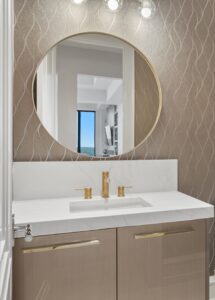
Stone Type Comparisons:
Here’s a comparative breakdown to help you understand how engineered stone compares to other stone types and which stone types are appropriate for which uses:
| Stone | Hardness | Veining/Pattern | Porosity |
|---|---|---|---|
| Engineered Stone | Consistent hardness; non-porous | Controlled, engineered patterns | Minimal porosity; easy maintenance |
| Granite | Hard and durable; resists heat/scratches well | Speckled, mottled; can have movement but less “flow” | Less porous than marble |
| Marble | Softer, more prone to etching & scratching | Beautiful flowing veins; high contrast | More porous; requires more maintenance |
| Quartzite | Hard and durable, often equal (and sometimes superior) to granite | Natural veining; dramatic patterning; sparkle | Less porous than marble |
Final Thoughts
Engineered stone is a sought-after choice for modern surfaces, combining design flexibility with reasonable cost and low-maintenance ease.
If you’re planning a kitchen remodel, bathroom upgrade, feature wall or custom stonework, contact Stone Fabricators today. With the right stone selection and expert fabrication/installation, you can enjoy surfaces that look beautiful, perform reliably, and withstand the test of time.